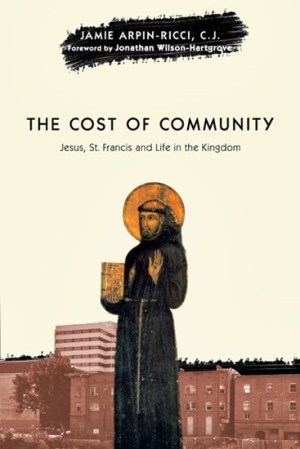
 Any book that seeks to combine the Sermon on the Mount, the life of St. Francis, and living in community is an ambitious undertaking. Overly ambitious maybe, as whole books have been written just on the Sermon on the Mount, or just on St. Francis, or just on living in community. And yet these three streams come together very well in The Cost of Community: Jesus, St. Francis & Life in the Kingdom by Jamie Arpin-Ricci.
The book is radical and uncompromising in its call to justice, peacemaking, and kingdom living:
We are called to believe the gospel in our hearts and minds. We are called to proclaim the gospel in our words and deeds. We are called to live the words of Jesus at all costs and without compromise. This is what it means to seek first his kingdom and his righteousness. (177)
Yet it’s not just a rant, since the tone is also realistic, clearly recognizing the challenges and tensions of kingdom living in the real world:
This isn’t something that can be achieved, but by his grace and his Spirit it is a shared way of life to be pursued more and more each day. Little Flowers Community has not ‘arrived’ at this high ideal, but rather we devote ourselves to living with such faith one day at a time. (177)
It even cautions against extremes:
While Francis’s literal adherence to this vow [of poverty] played no small part in the positive impact and authority he had in the church and wider culture of his day (and beyond), it is also quite clear that the extremity of his adherence was somewhat damaging as well. Even Francis, finding himself prematurely at the end of his life, repented to his suffering body for treating it so poorly. In the cold climate and harsh conditions, this vow left Francis literally blind and broken, leading to a death premature even by the standards of his day. (44)
I resonate with a lot in this book—reading the Sermon on the Mount in context and as a whole instead of “a random collection of maxims” (25), taking it seriously as a way of life, understanding the Lord’s Prayer as the Disciples’ Prayer, the many stories of St. Francis. But it’s in the account of Little Flowers Community that this book really comes alive for me. I wonder now, how is Amy and her daughter? Is Laura still struggling with her addiction to shopping? What happened to the two boys from the neighbourhood who got caught stealing the lawn mower and were let off with a warning?
These and other stories made me think about my own neighbourhood and community. Although I live in the suburbs, in a townhouse complex where the gates close automatically at night, The Cost of Community speaks into my life too. I think of the widow grieving her husband’s suicide after more than a decade struggling with mental illness. The single mom trying to stay clean so she can see her children who were taken away because of her addiction. For reasons of privacy and confidentiality, I won’t name names, but here in the suburbs there are also many challenges, and we need authentic Christian community as much as the inner city.
So I’m pleased to recommend this book—radical in the best sense of the word without falling into extremism, well-balanced without watering down Jesus’ teaching, with real-life stories and biblical teaching throughout. I like this book so much that I’ve suggested it to my husband as a possible textbook for the course he teaches on the Sermon on the Mount. But it’s not just for students and the classroom. If you’re interested in taking the Sermon on the Mount seriously and living it out, this book is for you.
For free email updates and a copy of How to Pray When Prayer Seems Impossible, sign up here.


 April Yamasaki
Please leave a comment: