I mainly agree with Megan Thomason who writes “Thou Shalt Not Read Reviews of Thy Own Book.”
After all, reading reviews can be distracting, disappointing, depressing, and to what end, since the book is already finished and published? If it’s a good review, I wonder why there aren’t more. If it’s lukewarm or downright bad, I wonder why I write at all. Either way, I know that reading reviews of my own books can be dangerous to my writing health.
Of course, sometimes I ignore my own best advice, and do it anyway.
That’s how I know that a reader calls one of my books “a new kind of consumer-friendly Jesuit spirituality.” It’s true that I wrote Sacred Pauses: Spiritual Practices for Personal Renewal as an accessible introduction for the non-specialist, as a new way to understand spiritual disciplines as sacred pauses that God can use to refresh us. So I should be glad the book is described as “new”– after all, no author wants to be tired and stale! And I hope the book is appealing and accessible, so maybe I shouldn’t mind it being described as “consumer friendly.”
But “Jesuit spirituality”?
That’s quite the contrast to a Mennonite Church pastor who said to me recently, “I really like your book because it’s so Anabaptist.”
Fellow MennoNerd, Tyler Tully, offers a historical and theological overview in “What are Anabaptists?” In it, he outlines three core Anabaptist convictions:
- the centrality of Jesus above all things,
- the essential community/free church of confessing, baptized disciples,
- the prophetic and non-violent witness of God’s peace.
As I consider the content, tone, and intent of Sacred Pauses, I can identify all three of these core convictions:
- The example of Jesus is central throughout the book, as Jesus himself practiced a rhythm of work and sacred pause.
- While the book is more about personal practice and renewal, community is also expressed in the spiritual practices of valuing relationships and worship in community. There is also encouragement to use this book with a friend or group, and I offer a free Sacred Pauses Group Guide.
- While little is said directly in the book about being “agents of God’s shalom” as Tully puts it, peace is expressed in the spiritual practices of confession, forgiveness and reconciliation, giving and living simply.
So yes, I can see why my pastor friend understands Sacred Pauses as Anabaptist.
At the same time, the book does refer to The Spiritual Exercises of St. Ignatius of Loyola, and there are several pages describing the Jesuit practice of prayerfully reviewing the day, ending with the Lord’s Prayer. Yes, it’s a practice from the Catholic church tradition, but I can’t see that it detracts in any way from the Anabaptist emphasis on the centrality of Jesus or the importance of community and peace.
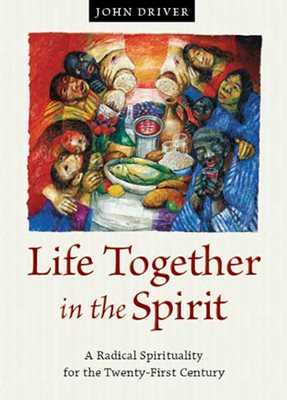 John Driver’s book, Life Together in the Spirit: A Radical Spirituality for the Twenty-First Century surveys Christian spirituality in the first century and in sixteenth-century Anabaptism, then concludes with a chapter on Anabaptists in conversation with others. He writes (page 96):
In the sense that Christian spirituality consists of following Jesus of Nazareth under the impulse of the Spirit, there is only one spirituality. However, in the sense that Christians seek to follow Jesus, each in his or her own particular historical context, there can be a diversity of Christian spiritualities. These differences are found in the variety of historical, geographic, and cultural settings in which discipleship is practiced. All of our spiritualities, without exception, can be enriched–thanks be to God!–through the contributions of brothers and sisters in other traditions.
What John Driver says about Christian spirituality is also true more broadly — just as our spiritual life can be enriched by other traditions, so too our spiritual vision, our theology, our faith and practice. As another fellow MennoNerd, Kevin Daugherty, points out, “the Anabaptist vision is spiritually and theologically lacking,” citing Stephen Dintaman’s article “The Spiritual Poverty of the Anabaptist Vision.” I don’t mean to pick on Anabaptists here, for the same could be said about any one tradition — our strengths can also leave us with blind spots, our core convictions may be over-simplified, and we can be enriched — as John Driver says, “thanks be to God! — through the contributions of brothers and sisters in other traditions.”
This article first appeared as part of a MennoNerds Synchro-Blog and has been updated since to remove links to old posts that are no longer available, to add the new cover to John Driver’s book, plus a new link to download Life in the Spirit as a free offer from Plough Publishing.
Writing/Reflection Prompt: What religious or other traditions have contributed to your spiritual practice?
_____________________
For more on writing and other acts of faith,
sign up here for free email updates and receive
a copy of How to Pray When Prayer Seems Impossible


 April Yamasaki
Please leave a comment: