At last week’s SBLAAR meetings, I was glad to see Drew Hart, now assistant professor in theology at Messiah College who also blogs for The Christian Century. We were both on our way to meet other people, so our exchange outside the Exhibit Hall was brief–so brief that I totally forgot to tell him how much I appreciated reading his book published earlier this year.
I can’t say that it’s a book to enjoy since it’s focused on racism in the church, but this is an important, powerful, and practical book. It gave me a better understanding of the church and racism in the U.S., and a lot to ponder for my own context in Canada. I highly recommend Trouble I’ve Seen: Changing the Way the Church Views Racism by Drew G.I. Hart (Herald Press, 2016).
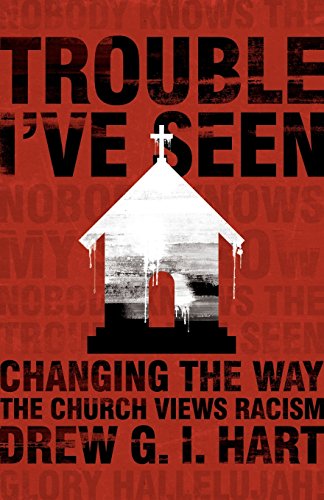
The book begins with the racial trouble he’s seen:
** His brother’s arrest for “fitting the description” of someone who had committed a crime. But the description itself was vague as a “black male with a black T-shirt and blue jeans,” and while his brother was eventually cleared in a line-up, his release came only after he had spent four months in a correctional facility.
** A long list of race-based violence, including the 1991 brutal beating of Rodney King by police officers, the shooting and death of 17-year-old Trayvon Martin in his own neighbourhood in 2012, the 2013 death of Renisha McBride who was shot and killed after knocking on the door of a house where she had hoped to get help after a car accident.
** Anti-black stereotyping; avoidance, denial, or defensiveness when faced with conversations about race; a “thin” understanding that defines racism as a horizontal divide between people and fails to recognize the vertical issues of power and hierarchy.
This makes for compelling reading–and all of that is just in the first chapter! The book goes on to develop what Hart calls a “thicker” understanding of racism that challenges assumptions and challenges the church. Instead of focusing on a thin view of racism as individual acts of prejudice, his thicker view considers racialized society with its police brutality, mass incarceration, poverty, and more.
Most importantly, he says,
Beyond changing how we view racism, we must live differently. We must be transformed. And we must be transformed not only for our own sake but because, every day, people are dying. Millions are dying slowly in our bloated prison system. Millions are dying while stuck in our ghettos, which are mostly death traps for poor and nonwhite people. . . . Right now justice is needed. Right now your own self-transformation is needed. Right now, your community can find deliverance by living into the birth, life, teachings, death, and resurrection of Jesus. We have lost sight of the reality that Jesus began a subversive and revolutionary movement in the midst of a troubled world. (page 180)
As you can tell from this quote, Hart is part preacher, with a clear call to follow Jesus who reached out in solidarity with those who were marginalized in his own time and place. In Jesus, we can be transformed, we can learn a new way to live that resists injustice, hierarchy, and racism. The book’s final chapter outlines some practical strategies, including sharing life together, practicing solidarity, and renewing social imagination by turning to Scripture and yielding to the Spirit.
A study guide by Katelin Hansen is available from the publisher–Trouble I’ve Seen Study Guide–and you can also download a free chapter. Please note though that this book is definitely written in and for the U.S. context, and contains some specialized concepts and language, e.g., white fragility, racialized hierarchy, counterintuitive solidarity. But don’t let that stop you from reading this excellent book on faith and race. I’ve already read parts of it several times, and my copy is heavily underlined, so it’s definitely a keeper.
Disclosure: I received a complimentary copy of Trouble I’ve Seen from Herald Press, and the opinions expressed in this review are my own.
Writing/Reflection Prompt: “When Jesus is depicted in your church, what race is he? What does this imply about the church’s theology?” (Study Guide, page 3)
For more faith-focused and writing-related articles,
please sign up for my weekly updates.
I’d love to keep in touch with you!


 April Yamasaki
Please leave a comment: