For today’s guest post, I’m pleased to introduce Sue Clemmer Steiner, who has served as a pastor in Ontario, Canada. Now retired and living in Kitchener-Waterloo, Sue continues to offer spiritual direction for church leaders, volunteers at a nearby federal women’s prison for a fiction reading group, and serves on the spiritual resources council of a local social service agency. Last fall she published a memoir, Flowing with the River: Soundings from my Life and Ministry. I plan to review her beautiful book in my next post, and in the meantime, here are some of Sue’s thoughts on sacred pause.
For at least 30 years I’ve kept a journal—not every day, but often enough to consider journaling a spiritual practice, a sacred pause.
In December I lugged two big boxes of old journals out of the closet. I arranged those books of many shapes and colours on some shelves, admired their beauty, then began reading them during my morning quiet times.
I entered into this endeavour with much curiosity and some trepidation. I wondered: could reading old journals be a sacred pause? Would they nourish me with streams of living water, or would my spirit shrivel up? Would returning to them comfort me or disturb me?
I’d considered reading my journals a year or two earlier, while writing my memoir, Flowing with the River. But I was afraid I’d get bogged down in all that self-reflection and never finish my book! This winter, with the book published (and in its second printing), the time felt right.

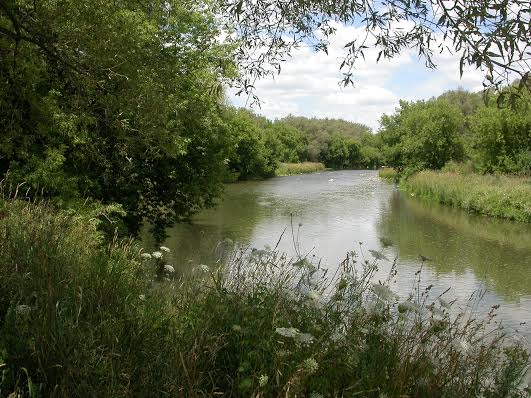
Photo © Samuel J. Steiner, 2013
I’m surprised at how compelling these recorded snippets of my inner journey are. Some days I can hardly pull myself away from them. My reading confirms that I was right to read them after completing my memoir, rather than during the writing process.
To my relief I’m finding that my memoir is true to the feelings and perceptions I recorded at crucial junctures on my life journey. My memoir is a distillation of what’s in the journals, tempered of course by the reflection on experience I’ve done in the meantime.
Reading the journals also confirms how actual bodies of water transport me to the river of the water of life. Vacationing by a lake or walking by the Conestogo River near home, I imagine myself wading in, finding the current, flowing with God’s Spirit, and being upheld by the healing energy.
I composed this worship poem on retreat nine years ago. I quoted it along with Rev. 22:1-2 at the beginning of my memoir:
My desire
is to be in the stream of history
moving ever more fully towards God
…basking in God’s steady, sturdy love towards me
…moving with the current as it flows
…knowing where some deeper currents lie
and inviting others in.May nothing distract me from flowing with this stream.
Journaling is one kind of sacred pause which helps many of us listen to our life with God. Now I know that for me, reading old journals is also a sacred pause, taking me to another level, plunging me deeper into the stream of God’s love and grace.
I’m reminded of this favorite quote from Frederick Buechner’s book Now and Then (Harper Collins, 1983):
Listen to your life. See it for the fathomless mystery that it is. In the boredom and pain of it no less than in the excitement and gladness: touch, taste, smell your way to the holy and hidden heart of it because in the last analysis all moments are key moments, and life itself is grace.
Writing/Reflection Prompt: Does journaling help you listen to your life with God? What value have you discovered in re-reading old journals?
_____________________
For more on writing and other acts of faith,
sign up here for free email updates and receive
a copy of How to Pray When Prayer Seems Impossible


 April Yamasaki
Please leave a comment: