 I was delighted to lead two seminars at this year’s Mennonite Church Canada Assembly in Winnipeg. Cultivating Spiritual Practices was the title suggested to me by Assembly organizers, but the sessions might just as well have been called Deepening Your Walk with God, or Growing Your Relationship with Jesus, or Developing Spiritual Discipline.
In the description of the “Wild Hope” Assembly theme, I read how recent social and cultural changes mean that “There is disorientation for God’s church.” How do we re-orient ourselves in the midst of great change? I believe that cultivating spiritual practices — deepening our walk with God, attending to the life of the Spirit, or whatever term we might use — can be part of that re-orientation.
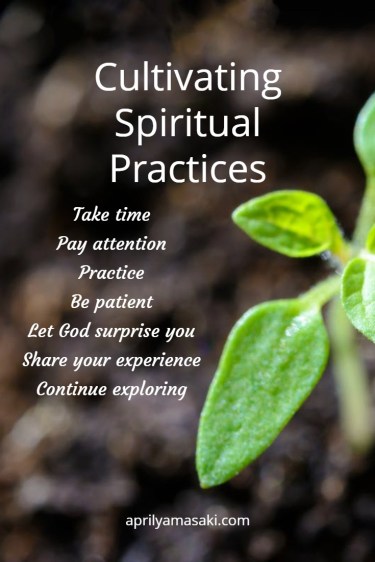
How can we cultivate spiritual practices? Below is my outline of this seminar.
1. Take Time
For some this might mean praying first thing in the morning even before breakfast. For one couple, it means reading Rejoice! at breakfast with each other and with any overnight guests invited to join them. I love taking time to journal, often at the end of the day or any time.
As I describe in Sacred Pauses: Spiritual Practices for Personal Renewal, it’s also become important for me to take sacred pauses throughout the day. A sacred pause might mean taking a moment to offer a prayer before jumping out of the car for my next appointment. It might be a classic practice like lectio divina, or packing up unused household items to simplify my life. Such sacred pauses can be ways of taking time for God.
As the 14th century The Cloud of Unknowing says,
It only takes a scrap of time to turn toward God.
2. Pay Attention
A sacred pause can be a moment, or half an hour, or a whole weekend like Pause: a weekend away.
Whatever scraps of time we might have, what sacred pauses have in common is paying attention — to God and to our own lives.
One of the classic disciplines of paying attention is the examen of consciousness first taught by Ignatius of Loyola. Here is one version that we practiced together in this seminar:
In a time of great change, Psalm 46:10 says, “Be still and know that I am God.”
[silent reflection]
As you look back over the past week, when have you taken time to turn toward God? Was it just a tiny scrap of time, or more? Give thanks for that time as a blessing and gift from God.
[silent reflection]
When in the last week have you sailed or struggled through life without turning toward God, and without even thinking of God’s presence with you? What were the barriers that kept you from turning toward God? Confess and release those barriers to God.
[silent reflection]
“God is our refuge and strength,
a very present help in trouble.
Therefore we will not fear, though the earth should change,
though the mountains shake in the heart of the sea;
though its waters roar and foam,
though the mountains tremble with its tumult.
. . . .
Be still, and know that I am God!
I am exalted among the nations,
I am exalted in the earth.”
The Lord of hosts is with us;
the God of Jacob is our refuge.” – Psalm 46:1-3, 10-11
[silent reflection]
3. Practice
We cultivate spiritual practices by repeating them. As keynote speaker Betty Pries said, the point is not to do these perfectly — even those who are well-practiced tend to speak of themselves as “seasoned beginners.”
4. Be patient
Spiritual practices might not always “work” the way we expect them to. At times we may feel as if our prayers aren’t going anywhere, or that God has nothing to say to us in lectio divina. When that happens, it’s okay simply to let that go, and to try again some other time.
5. Allow God to work and to surprise you
Words like “practice” and “discipline” might give the impression that spiritual life and growth depend on our effort. But it’s God who is at work in us and who grows us, who may speak to us in a dream or some other surprising way.
6. Share your experience
Many spiritual practices are shared practices — corporate worship, corporate prayer, corporate confession, hospitality, service. At the completion of our examen, seminar participants were invited to share their experience with a partner and with the group as whole.
7. Ask questions/explore/experiment
What else would you add to this list? How do you cultivate spiritual practices?
_____________________
Like this article? Please share it to encourage others,
and for more on acts of faith in everyday life,
sign up for my email updates and receive a free copy of



 April Yamasaki
Please leave a comment: