 This week marks the two-year anniversary of Sacred Pauses: Spiritual Practices for Personal Renewal. In a world that sometimes seems too busy, the book encourages us to pause, to take a step back and reconnect more deeply with ourselves and with God. I wrote the book out of my own longing for sacred pauses, and I’m grateful for the way it’s connected with college students, with women and men engaged at home and work, with people who are retired, with people of many different walks of life.
And yet I also have a problem with the book, because it’s incomplete. It only tells one side of the story. For as much as I believe that sacred pauses are wonderful and important–and even necessary to healthy living–the very wording implies that there are sacred pauses, and then there is another part of life that’s active-and-not-so-sacred. But the counterpoint to sacred pause isn’t unbridled busy-ness.
Instead, I believe that our daily work, our daily family life, loving our neighbours and community, our relationships as a church, caring for creation and for the world—all of that can be sacred activity, just as sacred as any pause might be. That’s the other side of the story that Sacred Pauses doesn’t tell. Faith-filled living is not only in the pauses, but in creative, purposeful, peace-making, active living. There is a rhythm of sacred work and sacred rest.
Because Sacred Pauses explores only one side of this rhythm, I keep thinking that I might need to write another book on work as sacred vocation or remain forever unbalanced. In the meantime though, I’ve read two excellent books that have helped me think more deeply about work in the context of faith. Here are some choice quotes from each book toward a theology of work:
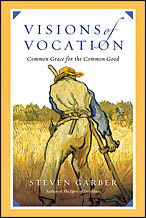 Visions of Vocation: Common Grace for the Common Good by Steven Garber (IVP Books, 2014).
On the meaning of vocation (page 11):
The word vocation is a rich one, having to address the wholeness of life, the range of relationships and responsibilities. Work, yes, but also families, and neighbors, and citizenship, locally and globally–all of this and more is seen as vocation, that to which I am called as a human being, living my life before the face of God. It is never the same word as occupation, just as calling is never the same word as career.
On good work (page 35):
There is good work to be done by every son of Adam and every daughter of Eve all over the face of the earth. There are flowers to be grown, songs to be sung, bread to be baked, justice to be done, mercy to be shown, beauty to be created, good stories to be told, houses to be built, technologies to be developed, fields to farm, and children to educate.
A prayer for the work week (page 239):
God of heaven and earth, we pray for your kingdom to come, for your will to be done on earth as it is in heaven. Teach us to see our vocations and occupations as woven into your work in the world this week. . . . Give us eyes to see that our work is holy to you, O Lord, even as our worship this day is holy to you. In the name of the Father, the Son and the Holy Spirit. Amen.
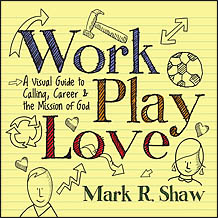 Work, Play, Love: A Visual Guide to Calling, Career & the Mission of God by Mark R. Shaw (IVP Books, 2014).
Work as delight (pages 35-36):
First, becoming a wisdom worker means playfully delighting in whatever we do each day. I will call this first delight the whatever. Second, it means playfully delighting in whomever we do it all with and for. I will call this the whomever. Third, it means making my delight in my almighty Father, who is at work everywhere around me and in me making all things new, the delight that drives all other delights. I will call this the wherever (as in, God is at work everywhere around us and in us.). . . . To work like Wisdom works means more than just “doing my duty” or “managing my responsibilities.” When I bring this spirit of play into the realms of work, play and love, I will flourish in all areas, and balance will be restored.
Work as playing with God (pages 64-65):
Traditional views of work define it as “purposeful activity involving mental, emotional or physical energy or all three whether remunerated or not.” Technically there is nothing wrong with this definition. But describing work this way is like describing a Beethoven symphony as purposeful group-generated sound involving blowing, plucking and beating various mechanical instruments either for pay or not. It may be technically true, but it misses the soul of the activity. . . . Work is playing creation with God.
There is some overlap between the two books as both address vocation and work, both are helpful for people in transition, whether just starting out or in mid-life. Visions of Vocation is a solid, thoughtful read, somewhat more oriented to the world of work. Work, Play, Love feels more casual with sketches throughout and explores work more broadly in the context of play and relationships. I’m glad that I read them both together.
Thank you to IVP Books for providing me with review copies. As in all my articles, opinions expressed here are my own.
To read at your own pace without missing anything,
sign up for my email updates and receive
a free copy of How to Pray When Prayer Seems Impossible


 April Yamasaki
Leave a Reply to melodiemillerdavis Cancel reply