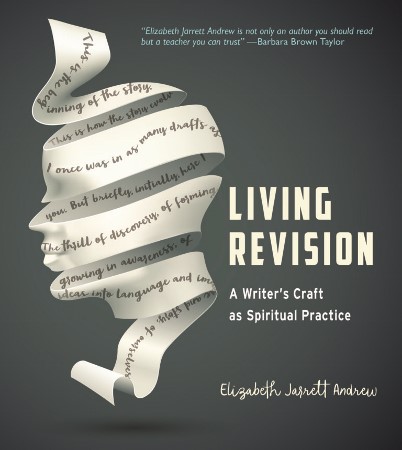
If you write for your eyes only in a personal journal, if you’ve written books for publication or aspire to, if you blog or write poetry or short stories or sermons, if you write letters, or have put together your family history for your kids and grand-kids, if you write at all, you’ll appreciate Living Revision: A Writer’s Craft as Spiritual Practice by Elizabeth Jarrett Andrew.
For me, writing has always been more than writing–it’s self-discovery, thinking on paper, exploring new ideas, playing with words, a creative art, an act of faith, a labour of love, a form of prayer, a way of life, a way of connecting with other people, and so much more.
Elizabeth Jarrett Andrew understands writing that way too. For her, a writing project is alive and helps us come alive too. A story has a soul, and a book has a heartbeat. So to write, we need to listen well, to spend time on vision and re-vision, literally re-seeing the story, the poem, the book.
I especially appreciate the author’s approach, since I’ve been working to revise my own book manuscript. It’s already been through multiple drafts, and I finally submitted all 44,558 words a month ago. Of course, even then I knew it wasn’t finished. I had left a few of my footnotes incomplete that I needed to fix. I wondered about adding an epilogue after the final chapter. I still needed to write a dedication and my acknowledgments.
Now that I’ve heard back from my editor, the time has come to do all of that. As Living Revision puts it, this is the time to re-see the book. At this stage, some of the changes involve details of punctuation and word choice, but there’s also the opportunity to dig deeper. Does the opening story of Chapter 5 work better later in the chapter? Does the book need an epilogue to become whole? I’m listening carefully for the heartbeat of my work.
Living Revision takes the reader-writer from rough draft through various stages of revision to completion. It includes many illustrations and quotes from a treasure trove of writers, from E.B. White to Margaret Atwood to Maxine Hong Kingston, Flannery O’Connor to Zora Neale Hurston to Leonard Cohen, Chimamanda Ngozi Adichie to Nadia Bolz-Weber to Jonathan Franzen, and many more. The book was a delight to read the first time through, and I hope to go through it once again for the ample writing exercises and tool boxes.
Here are just two of the exercises I’ve bookmarked:
In what areas of your life are you good at resting? Choose one and explore it. Does rest come naturally here or did you have to learn to allow it? What happens to your body, mind, and spirit when you step away from work? How might you apply this wisdom to your writing? (46)
Imagine that your draft is a murder mystery. You’re the detective. Journal in response to these questions: What is the unsolved question you are pursuing? What clues has your draft dropped that might help you solve this mystery? Are there any pieces of evidence missing? Who are the witnesses, and what do they reveal? (122)
For now, I’d better get back to the revisions before me, but I look forward to spending more time with Living Revision.
Disclosure: I received a complimentary copy of this book through Speakeasy. As in all my reviews, the choice to review and the views expressed are my own.
Writing/Reflection Prompt: In ten minutes, write your earliest fond memory of writing. Then reflect: What happened in that moment? What came alive? (from Living Revision, 11).
If you’re interested in more writing and faith-focused articles,
please sign up for my free email updates,
and you’ll also receive a copy of How to Pray When Prayer Seems Impossible.


 April Yamasaki
Leave a Reply to Craig D.Helm Cancel reply