When I heard about Rebecca Brewster Stevenson’s new book on waiting, I could hardly “wait” to read it. I’ve featured other posts on waiting, and for my next subscriber bonus, I’m planning a short ebook on How to Wait Well. I hoped that her new book might add to my own understanding of waiting and be a helpful resource to you as readers.
Wait: Thoughts and Practice in Waiting on God by Rebecca Brewster Stevenson (Light Messages Publishing, 2019) is a beautifully written reflection on waiting that weaves together Scripture, poetry, and the author’s personal story. I especially appreciated the chapters exploring home/exile and expectation/expectancy. And I was so taken by the book as a whole that I’m glad to feature this guest post by the author AND give away a free copy. To enter the draw, leave a comment at the end of the post, or join my list for regular email updates. Thank you, Rebecca, for sharing your story!
From Expectation to Delighted Expectancy
by Rebecca Brewster Stevenson
In July 2001, my husband and I were parents to three young children when my husband lost his job.
Despite his advanced degree from a top business school and years of experience and hard work, despite warning signs that his start-up was going to collapse, despite months in advance of looking for another job, we were suddenly cut adrift.
Two months later, the events of 9/11 sealed the deal: no one was hiring in the world of marketing and rising technologies. In addition to our recently realized lack—no income, severance pay or health insurance—we could add another: no job prospects whatsoever.
That’s when our wait began, and I was terrified. Had we known at the time that this wait would extend over a decade, that—even now, eighteen years later—we would still be on uneven financial footing, I think I might have collapsed.
And yet our predicament was not uncommon. Job loss and the wait for employment strike many. It’s only one of many kinds of waiting.
What Does It Mean to Wait?
Ask anyone. Take a random survey of the people in your subway car or standing in line at McDonald’s: most people are waiting for something. And I don’t mean that they’re waiting for their stop or their turn to order lunch. I mean most people are dissatisfied, needing something to change, wanting something to develop. Most people are hoping that something will—someday—be different.
If you are a Christian, then this dissatisfaction automatically becomes—whether or not you think about it—a matter of waiting. Why? Because you have a relationship with the living God. You put your hope in the author of the universe. And you know that if the living God and author of the universe willed it, everything could change.
God could provide you with the perfect job. The perfect spouse. The longed-for baby. Restored relationships. Health.
You name it: the author of the universe can do it. Moreover, you know that someday the living God will satisfy every longing, every need.
What are you waiting for?
Waiting Means Learning to Trust God
 If you are waiting on God and have asked him to meet your need, then you likely have one of three answers: if he has not said No, if he has not said Yes, then he has told you to Wait.
“Yes” is the answer we want. It’s the response that sends us happily on our way, doing and learning to do the next thing. “No” is the answer we dread, potentially opening us to times of questioning, hurt, and doubt.
But “Wait” has its own darkness. It can suggest disinterest from God, even abandonment. It can mean years of suffering, of limbo, of protracted inaction. We don’t like it at all.
And yet look again at our responses to those potential answers. Where “yes” sends us along our merry way, both “no” and “wait” turn our faces to God. They give us undesired, sometimes agonizing pause—but they give us pause nonetheless.
I didn’t want God to hit the pause button when our children were so young. I wanted financial security so that we could be about the business of rearing our children. Instead, we got the business of rearing our children (which will never wait) while also struggling with fear—and learning to trust God. It was—and is—a difficult and invaluable time.
Waiting Means Relationship
“I just want to learn whatever it is I’m supposed to learn from this.”
Have you heard this before? Have you said it before? I have. And at first blush, it makes a lot of sense. Faith-filled and hopeful, we know God has power to grant whatever it is we want or need. So we begin to look for the good. Surely God is teaching us something, shaping us in some way. Like the clay in Jeremiah’s prophecy, like the proverbial child disciplined in Hebrews, we believe God is at work in our waiting.
And yet this common phrase, “I just want to learn whatever it is I’m supposed to learn from this,” is also a cry of impatience: we want to get through whatever God is teaching us so that we can get back to life as we prefer it. We don’t actually want our faces turned toward God. Instead, we want the discomfort to end, the dissatisfaction to be satisfied.
We want God to hurry up and get the lesson over with.
And in that moment, we turn God into a lesson. We turn God’s work into a curriculum. And—at some level—we reject the opportunity of deeper relationship.
Waiting is an invitation to know God in a new way—but we don’t get to decide what that new way will be. As believers, our wait becomes hope—but not hope in a specific outcome. Rather, our hope is in God himself.
Waiting Means Releasing Expectation
Take the disciples for example. Roused from their slumber by the arrival of Judas and the temple soldiers, the disciples believed that the wait for conquest was over: here was the beginning of the rebellion! The Messiah would rally the people who only a day before had cheered his entrance into Jerusalem. Peter drew his sword and, likely, other disciples followed suit.
Until Jesus put an end to it.
Peter’s hope—and expectation—seemed more in conquest and in Rome’s overthrow.
But salvation and God’s Kingdom were not coming that way. Dominion would not be gained through bloodshed—not the bloodshed of Romans, anyway. No, dominion and the Kingdom would come through Christ, through his shame-filled death and glorious resurrection.
When my husband lost his job, I wanted another job to be the answer to it—preferably a better job, with better pay and benefits. Instead we’ve had myriad disappointments, the brink of bankruptcy, and practice—again and again—at putting all of our hope in God, no matter what comes our way.
A beauty and gift of waiting has been the deliberate release of our expectation—that God would act in the way we want or hope—and a growing sense of delighted expectancy: that God will be good in whatever way he chooses, that we are his beloved children, cared for by his hand.
Our expectations ground us: they name the stuff that we believe will satisfy. But they also blind us to what God is doing. They are distractions, naming imagined good instead of the work that God is doing.
Don’t wait for an outcome. Wait for God. Instead of waiting in expectation, wait in expectancy—trusting in the very nature of God, who is always good. Only then will you be satisfied, because true satisfaction is in God.
Writing/Reflection Prompt: What lessons have you learned from waiting?
To enter the draw for a free copy of Wait, leave a comment or subscribe to my free updates. Contest closes July 29, 2019, 9am Pacific.
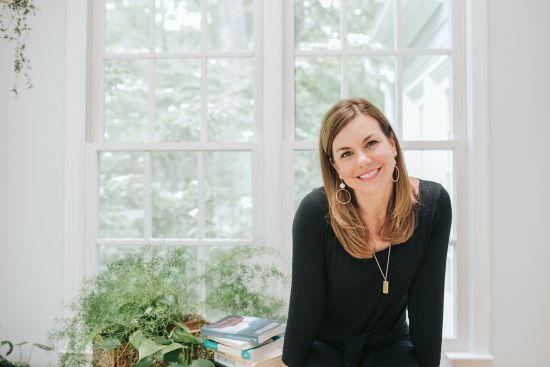
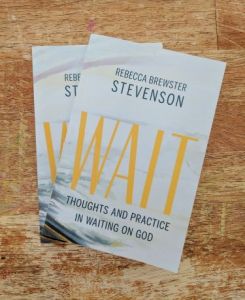 Rebecca Brewster Stevenson writes in Durham, North Carolina, where she lives with her husband and children. She taught English in private and public schools before becoming a mother, and then homeschooled her children for several years. After earning her Masters degree in Liberal Studies from Duke University, she returned to teaching full-time, this time as a founding member of the high school faculty at Trinity School of Durham and Chapel Hill. In 2012 she left teaching to pursue writing full-time, and is author of the critically acclaimed novel, Healing Maddie Brees. She recently released her second book, Wait: Thoughts and Practice in Waiting on God (Light Messages Publishing, 2019).
For more on everyday acts of faith,


 April Yamasaki
Leave a Reply to Louise Cancel reply