In many ways, the story of Exodus is the story of women. Women who acted with faith and courage. Women who took creative initiative. Women who were well-positioned or oppressed, younger or older, named or unnamed in the biblical text. Without these women, there might have been no Moses and a very different Exodus story.
A Story of Oppression
Exodus 1 begins by naming the sons of Israel who moved to Egypt with their families. Their generations multiplied, and a new king became so fearful of their numbers and strength that he forced them into hard labour. He even ordered their midwives to kill any Hebrew boys at birth.
At that point, the story shifts to focus on the women. For the midwives refused to follow the king’s orders. Out of their deep faith and reverence for God, Shiphrah and Puah acted with courage to let the boys live. Undeterred, the king issued an order to all the people: “Every son that is born to the Hebrews you shall throw into the Nile, but you shall let every daughter live” (Exodus 1:22).
A Story of Courage
Exodus 2 continues the story of the midwives’ courage with a young mother who gave birth to a healthy son. She and her family managed to hide him for three months. But when they could conceal him at home no longer, she placed him in a basket, and set him on the bank of the river. Her older daughter stayed to watch over her brother to see what might happen next.
This early part of the Exodus story does not name Moses or his sister. But later genealogies call Moses’ only sister Miriam (Numbers 26:59, 1 Chronicles 6:3), and she later appears as a prophet and leader (Exodus 15:20–21, Micah 6:4).
But all that was still to come. As a young girl, Miriam and her family lived in captivity. Generations earlier, the Hebrew people had been welcomed and accepted in Egypt as descendants of Joseph, who had been second in command only to the king. But now they were an oppressed people with a death sentence on all their baby boys; only the female children were allowed to live.
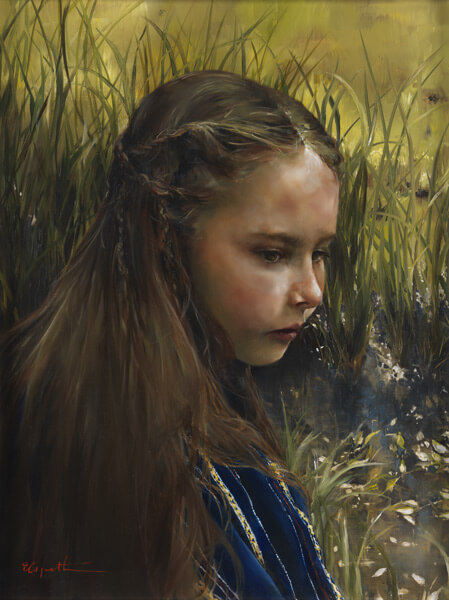
Ironically, it ws a girl child who played a key role in thwarting the king’s command. After Moses’ mother placed Moses in the river, it was Miriam who watched over him. When the king’s daughter came to the river and discovered the basket with the infant boy, it was MIriam who offered to find a Hebrew woman to nurse him. When the king’s daughter agreed, Miriam called her mother. Even as a young, unnamed girl, Miriam showed the initiative that would one day make her a leader.
Image caption: By the River’s Brink {Miriam}. Copyright by Elspeth Young. All Rights Reserved. Courtesy of Al Young Studios.
A Story for Today
This ancient story continues in our own time. The extreme circumstances of oppression that Miriam and her people faced are still part of our world. Like the ancient Hebrews, some peoples today still suffer the systematic attempts of others to destroy their culture, their livelihood, their children, their lives. Too often, nations still oppress nations, and those in power still rule unjustly.
For those who suffer opression, the story of Miriam stands as an example of positive action in oppressive circumstances. Although she was young, she did what she could. Although she was just one individual, she exercised what power of courage and creativity she possessed. She could not immediately change the circumstances of her people, but she would not stand idly by. Instead, she did what she could and prepared the way for freedom.
For those who have been spared such oppression, the story of young Miriam stands as an invitation to join with all those who are oppressed. Like Moses’ sister, we can watch over the events of our world to see what will happen. Like her, we can remain informed and ready to act. We can offer creative solutions to those in authority. We can use whatever personal, economic, and political power we might have to take positive action.
Above all, we can remember that we do not act alone. For all her initiative, Miriam did not act alone in saving Moses. Against the orders of the king, Shiphrah and Puah let Moses and all the infant boys live. Moses’ mother made the basket, committed him to the waters, and later became his nurse. The king’s daughter took Moses from the river, paid his mother to nurse him, and later brought him into the royal household. Miriam was part of a whole company of women whose combined efforts saved Moses, changed lives, and changed history.
In the same way, we do not act alone. Instead, we can act with and on behalf of many others—with faith and watchful waiting, with courage and creativity that comes from God.
An earlier version of this reflection appeared in Remember Lot’s Wife: Unnamed Women of the Bible. The book is out of print, and I now hold the copyright, so I’m thinking of revising and re-issuing it with a new title, and perhaps as a shorter series of ebooks. To respond to this reflection on the role of women in the Exodus story, and/or if you have any counsel for me on re-publishing Remember Lot’s Wife in some form, I’d love to hear from you, so please leave a comment.



 April Yamasaki
Please leave a comment: