It seems that everyone is getting younger these days: 70 is the new 40, 40 is the new 25, and even 30 is the new 18. From the clothes we wear to our hair colour, from work out tips to the latest skin creams and cosmetics, it seems as if we want to look young, act young, stay young for as long as possible.
Yet the reality is that each of us is growing older by the minute, and far from avoiding it or covering it up, we might well recognize that growing older is a gift. After all, not everyone gets to grow old. Or as Maurice Chevalier observed somewhat humorously, “Old age isn’t so bad when you consider the alternatives.”
I’m happy to recommend two excellent resources that explore this gift of growing older—for those who are already in their senior years; for those who have an older adult in their life as a parent, relative, or friend; or for anyone who works in ministry with older adults.
 Rich in Years: Finding Peace and Purpose in a Long Life by Johann Christoph Arnold (The Plough Publishing House, 2013) is an honest look at some of the challenges of growing older, with chapters like Accepting Changes, Combatting Loneliness, Finding Purpose, Living with Dementia, Finding Peace, Saying Goodbye. The author is in his seventies, a pastor and member of the Bruderhof, who shares his own experience and reflections, as well as the stories of Alice, Vince and Jean, Dick, Emmy, and others.
This is not a book of facts and figures about aging or how to deal with finances or other practical matters. Instead, this book takes a larger view: for however many years we are granted on this earth, how do we live with peace and purpose? how can we live a rich life when we are rich in years?
I appreciate the author’s summary (page 95):
In a nutshell, this is the secret: to be faithful, and to hang on. If we do this, we will find that it actually doesn’t matter how long we live; God is more concerned that we simply serve him and trust him to the very end. For the true measure of time is not found in years, but in living in accordance with our primary purpose here on earth: to love others.
This is good counsel at any age or stage of life—to be faithful and to hang on to God through all of life’s challenges at 20 or 40 or 70 years or beyond. While these challenges are different for those in their senior years, the way of peace and purpose remains the same throughout all of life.
As the author demonstrates throughout this book, “Whether we begin to serve and love early or late in life, there are always opportunities to do so, no matter how sick or weak we are” (page 97). And even when dementia is severe, even when the physical end of life is near, “Ultimately, Jesus can and will use us, even if our minds and bodies are broken and decaying” (83).
This is an encouraging book and filled with hope—not the vain hope of staying forever young, but the sure hope in God who gives us life and breath and who sustains us to the end.
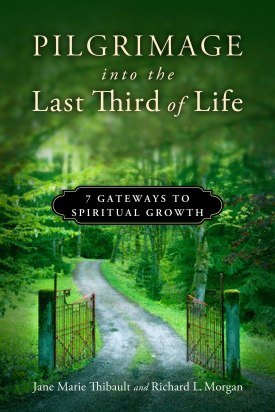 Pilgrimage into the Last Third of Life: 7 Gateways to Spiritual Growth by Jane Marie Thibault and Richard L. Morgan (Upper Room Books, 2012) is written as a series of meditations on Scripture with questions for reflection. The co-authors write out of their personal experience at age 65 and 83 respectively, and also draw on the experiences of others to explore what they call the 7 gateways to spiritual growth: (1) Facing Aging and Dying; (2) Living with Limitations; (3) Doing Inner Work; (4) Living In and Out of Community; (5) Prayer and Contemplation; (6) Redeeming Loss and Suffering; (7) Leaving a Legacy.
Some of the questions for reflection are focused on the challenges of aging. Like “How many times have you moved in your life? Did those moves bring happiness? “What kind of a community would you choose to live out your final years?” (page 72) Others are helpful at any age: “How could you create a simpler lifestyle with time for prayer, meditation, and service?” (page 61) “Do you invest more of your energy in caring for your possessions than in your relationships?” (page 80)
I’m already looking for an opportunity to share the Prayer for Aging at the start of the book with seniors in my congregation. It says in part (page 7):
As my legs weaken and walking becomes more difficult,
may I walk more truly in Your paths,
knowing all the while that I am held in the embrace of Your love.
As my mind becomes less alert and memory fades
may I remain peaceful in You,
aware that with You there is no need for thought or word.
You ask simply that I be there, with You. . . .
Finally, as my heart slows a little after the work of the years,
may it expand in love for You and all people.
May it rest secure and grateful in Your loving Heart
until I am lost in You, completely and forever.
Amen.
I read these two books together and found that they complemented one another very well. Both are hope-filled, encouraging, and wise. Both are realistic about the specific challenges of growing older, yet also see these in continuity with the rest of life, as all of us—younger and older alike—share the human task of finding peace and purpose in life. Ultimately for both, this peace and purpose are found in the gift of God.
Disclosure: I received complementary copies of both of these books from the publishers/authors with no requirement to write a positive review. As always, the opinions expressed here are my own.
_____________________
For more on writing and other acts of faith,
sign up here for free email updates and receive
a copy of How to Pray When Prayer Seems Impossible


 April Yamasaki
Leave a Reply to Geraldine Cancel reply